
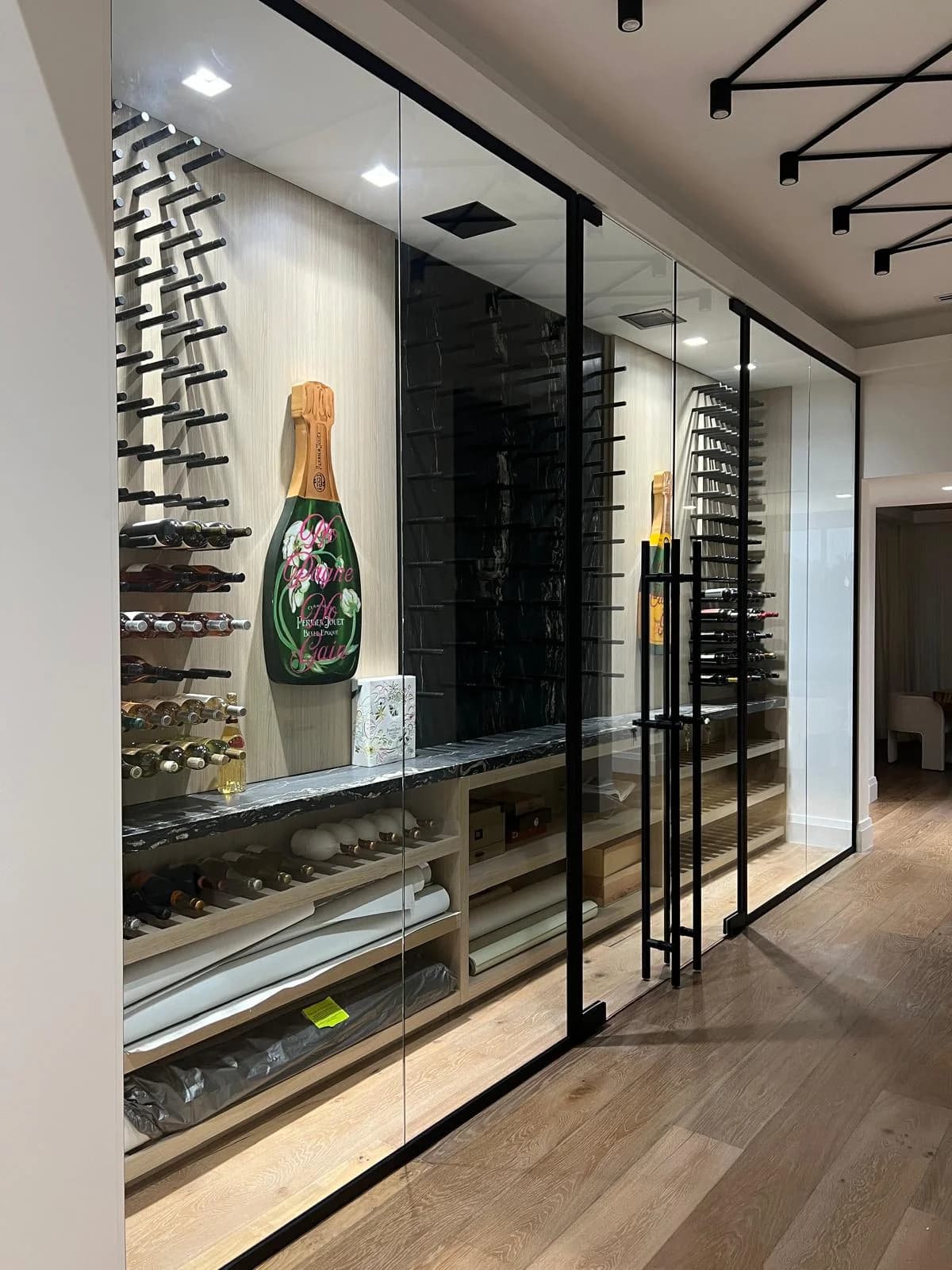
Glass Wine Cellars in South Florida: How to Keep Your Collection at 55°F
Ideal temperature and humidity, condensation in Florida’s climate, single vs. insulated glass, and how to keep light from damaging your wine.
Key takeaways
- Wine stores best at a steady 55–58°F with roughly 50–70% relative humidity (around 60% is a common target).
- Stability matters more than the exact number — frequent temperature swings are what age wine prematurely.
- In Florida’s heat and humidity, cold glass can sweat. Insulated (dual-pane) glass keeps the outside surface warmer and clearer.
- A vapor barrier on the warm side of the insulation is essential in humid climates.
- UV light causes “light strike.” Keep glass rooms out of direct sun and use LED lighting, which emits very little heat and UV.
On this page
A glass wine room turns a collection into the centerpiece of a home — in the dining room, under the stairs or right off the kitchen. In South Florida, though, heat and humidity make how you build it just as important as how it looks. This guide covers the conditions wine needs and the design decisions that protect it.
55–58°F
Recommended storage temperature
50–70%
Recommended relative humidity
3 hrs
Sun exposure that can light-strike wine in clear bottles
The four enemies of wine
- Heat. Warm storage speeds up aging and can “cook” delicate wines.
- Temperature swings. Expansion and contraction can push air past corks. A steady temperature is the goal.
- Light. UV light breaks down compounds in wine and creates off-aromas — a flaw called light strike. White, rosé and sparkling wines in clear bottles are most vulnerable.
- Wrong humidity. Too dry and corks can shrink; too humid and you risk mold and damaged labels.
The Florida challenge: condensation
When the inside of a wine room is held near 55°F and the air outside is warm and humid, any surface that conducts cold to the outside — especially glass and metal — can drop below the dew point and sweat. Condensation isn’t just unsightly: it can drip onto floors, feed mold and make the cooling system work harder.
A costly mistake
Wine room builders report Florida projects that had to be torn back to the framing because no vapor barrier was installed behind the insulation. The vapor barrier belongs on the warm side of the insulation — not the cellar side.
Choosing the right glass
| Glass option | How it performs | Best for |
|---|---|---|
| Single tempered glass | Beautiful and clear, but low insulation value; more prone to condensation | Display rooms with modest temperature difference, or where the cooling system is sized for the load |
| Insulated glass (dual-pane) | Air space between panes keeps the outer surface near room temperature and reduces sweating | Actively cooled cellars, especially walls facing warm or humid spaces |
| Low-E / UV-filtering glass | Coatings reduce heat gain and UV transmission | Rooms that receive daylight |
Actively cooled wine cellar
- Dedicated wine cooling unit holds ~55°F and target humidity
- Insulated walls, ceiling and vapor barrier
- Tightly sealed glass door with weatherstripping and threshold
- Best for long-term aging and valuable collections
Display wine wall
- Glass enclosure within the home’s air-conditioned space
- Showcases bottles you’ll drink in the near term
- Simpler construction and lower cost
- Not intended for long-term cellaring
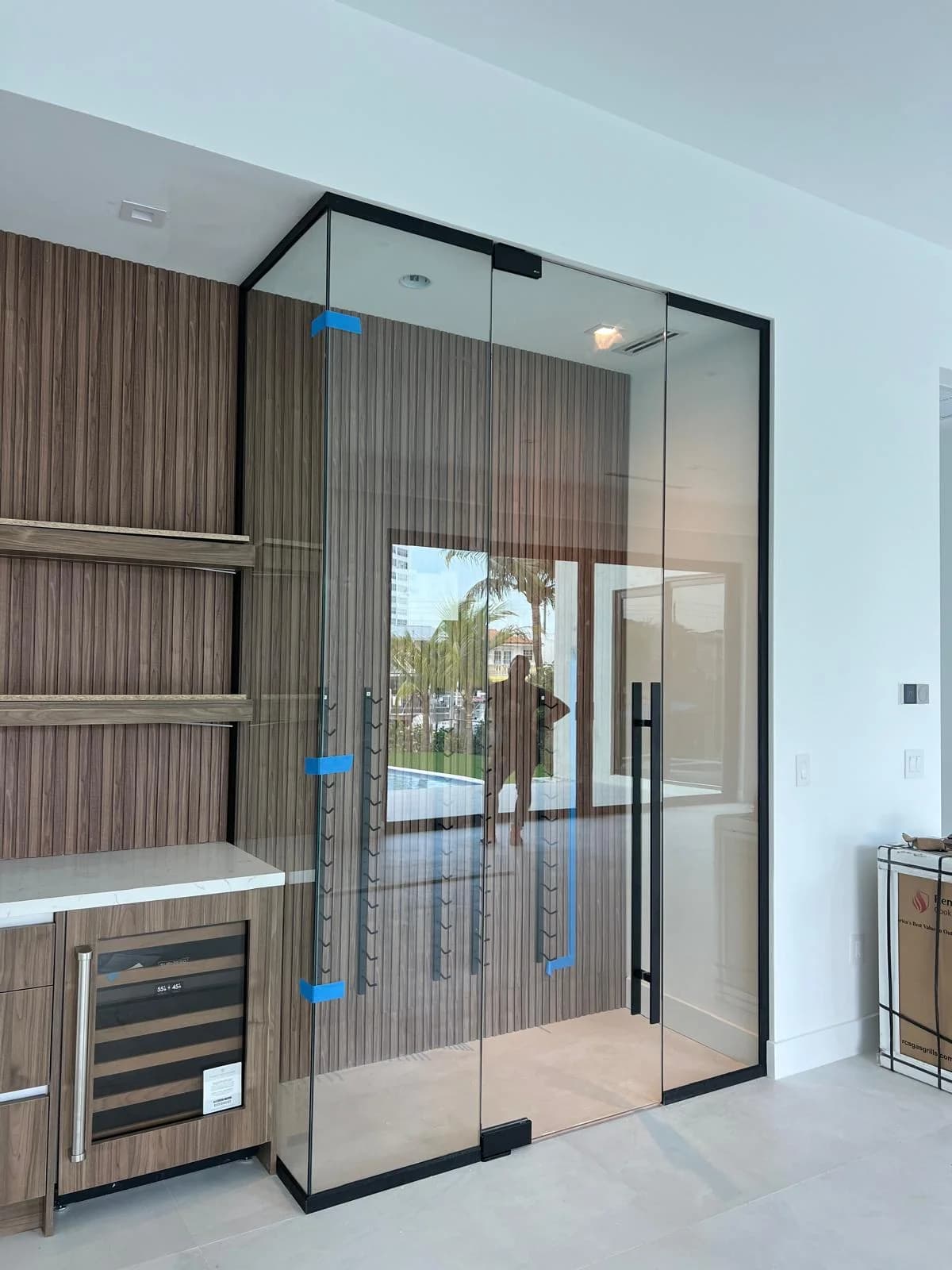
Protecting wine from light
- Place the wine room on an interior wall, away from windows and direct sun.
- Use LED lighting — it gives off very little heat and very little UV compared with other sources.
- If the room receives daylight, consider UV-filtering or low-E glass.
- Store light-sensitive wines (whites, rosés, sparkling) in lower or less-exposed racks.
How a glass wine room comes together
- 1Choose the location. Interior spaces such as under-stair areas, dining rooms or dens work best. Avoid garages and sun-exposed walls.
- 2Decide: display or active cooling. This determines insulation, glass type and equipment.
- 3Build the envelope. Framing, insulation and a continuous vapor barrier on the warm side.
- 4Size the cooling system. A dedicated wine cooling unit — not the home’s standard A/C — sized by a specialist for the room and its glass area.
- 5Measure and install the glass. Final measurements are taken after framing and finishes; then glass walls and a sealed door are installed.
- 6Add racking and LED lighting.
What Eastern Glass handles
We design, fabricate and install the glass: full glass walls, custom glass doors and sealed enclosures, including under-stair and walk-in wine rooms. We coordinate with your contractor and wine cooling specialist so the glass works with the room’s climate system.
Frequently asked questions
Most guidance recommends a steady 55–58°F with relative humidity between about 50% and 70%, with around 60% as a common target. Keeping conditions stable is more important than hitting an exact number.
Sources & references
- [1]Wine Cellar Temperature and Humidity Guide — Wine Cellar Authority
- [2]Wine Cellar Construction Guide — Kessick Wine Cellars
- [3]Vapor Barrier Wine Cellar Guide — Breezaire USA
- [4]Storing Wine in Humidity — VintageView
- [5]Will LED lights in my cellar harm my wine bottles? — Wine Spectator
- [6]Light Strike: Why Wine and Sunlight Don’t Mix — Wine Folly
Design a glass wine cellar that protects your collection
Tell us about your space and collection. We’ll help you plan glass walls and a sealed door that look spectacular and work with your cooling system.
- Full glass walls & custom doors
- Under-stair & walk-in designs
- Free consultation
Free estimates · We respond within 24 hours
Keep reading
All articles →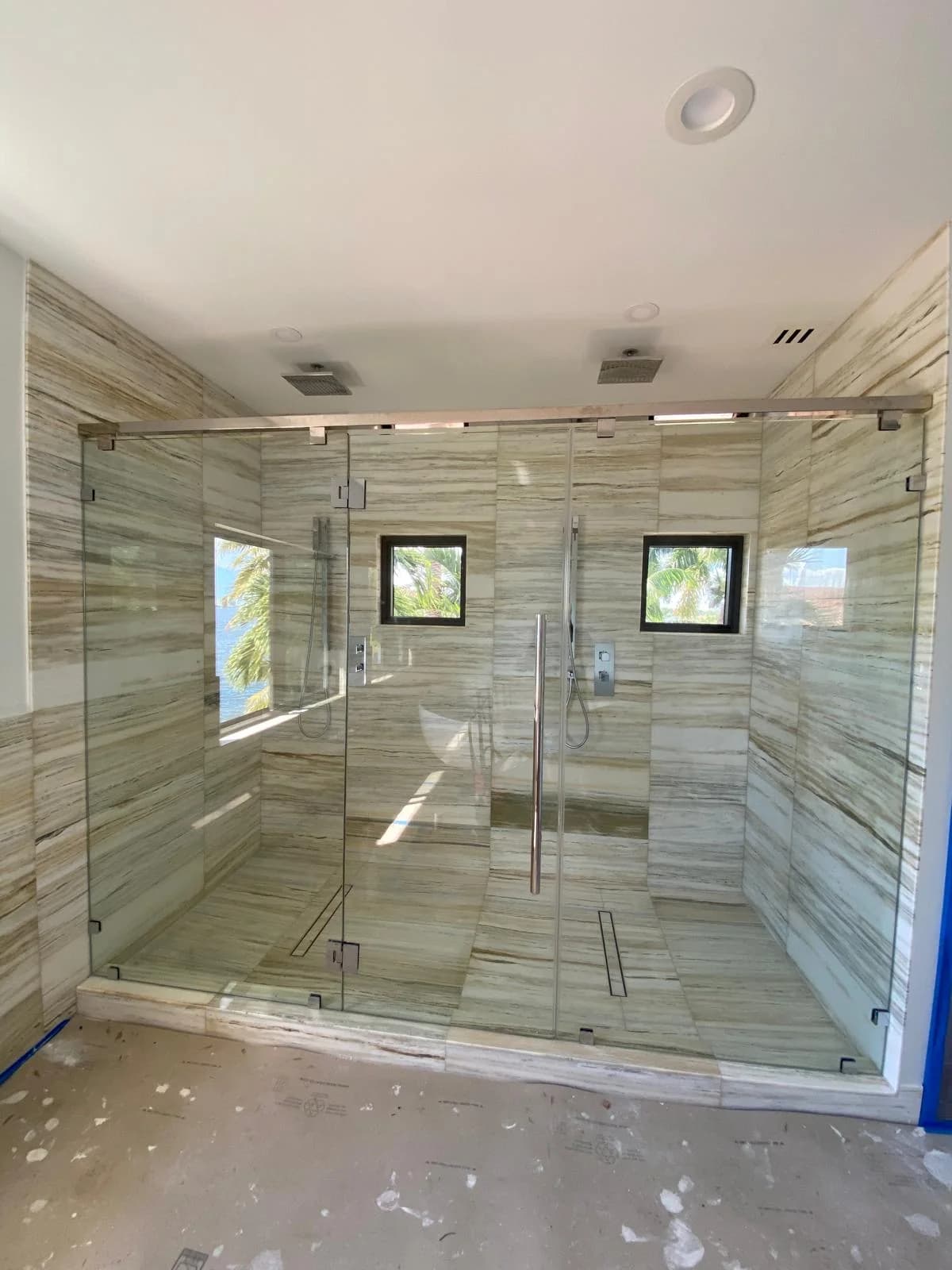
Frameless Shower Door Cost in Miami (2026): What You’ll Actually Pay
Real 2026 price ranges for framed, semi-frameless and frameless shower doors — plus the 7 factors that move your quote up or down in South Florida.
Read article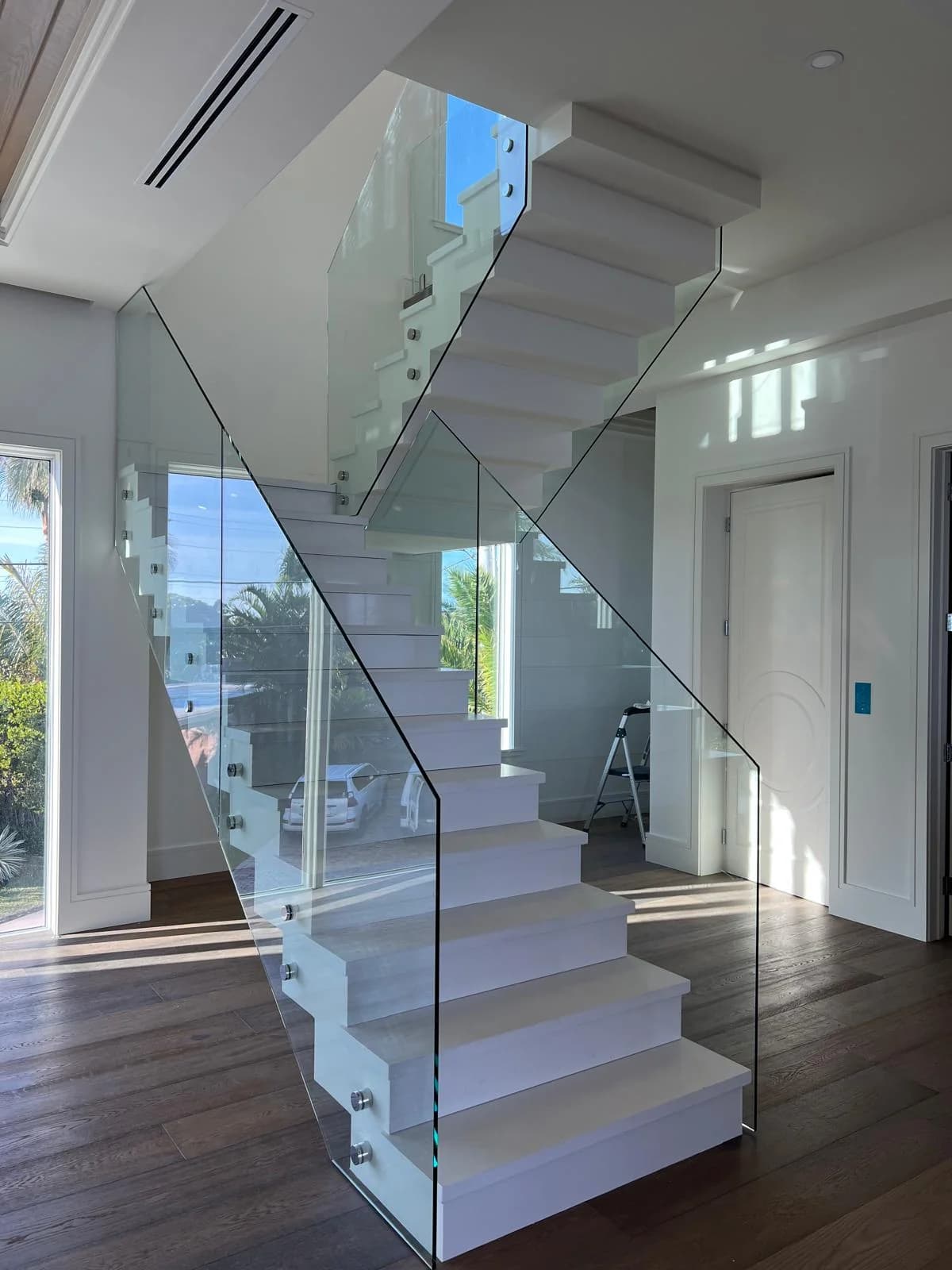
Glass Railings in Florida: Building Code Requirements Homeowners Should Know
Guard heights, the 4-inch rule, tempered vs. laminated glass, hurricane zones and permits — the Florida code essentials in plain English.
Read article
Frameless vs. Semi-Frameless Shower Doors: Which Is Right for Your Bathroom?
A side-by-side comparison of looks, glass thickness, weight, cleaning and cost — plus when 1/2" glass is actually worth it.
Read article